

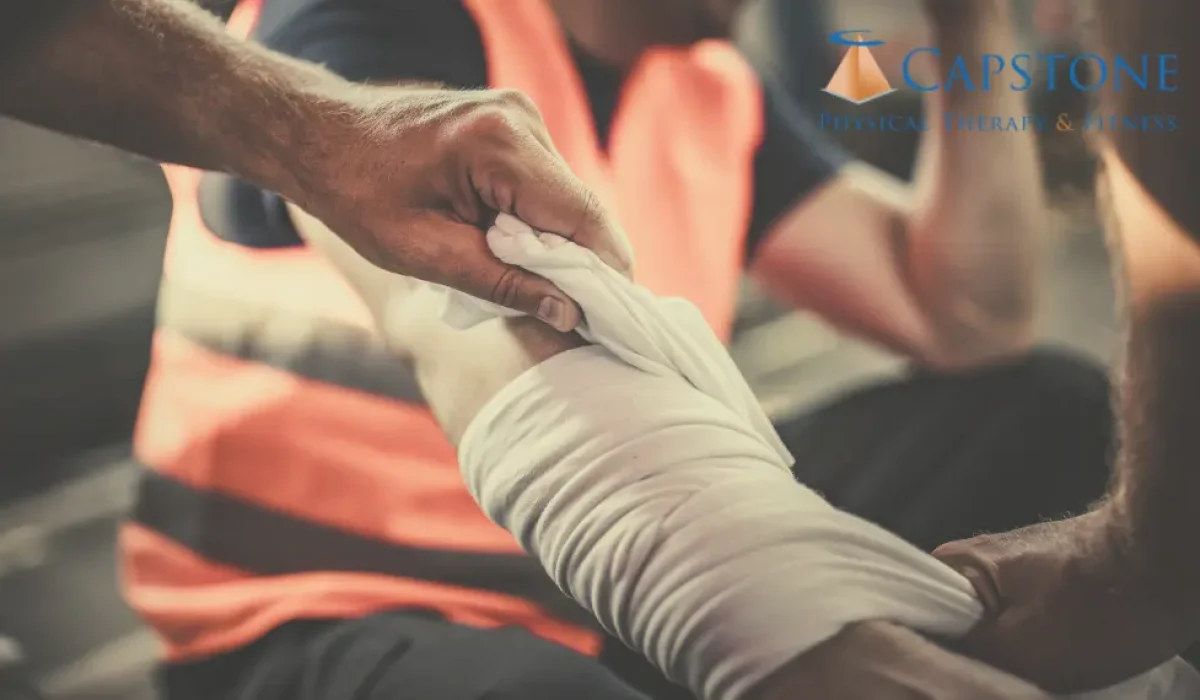
You pushed through the pain at work, thinking it would get better on its own. Or maybe you felt something pop during a weekend game and hoped a few days of rest would fix it. Now, weeks or even months later, you’re still hurting—and wondering if you’ll ever feel like yourself again.
If this sounds familiar, you’re not alone. Thousands of Philadelphia and Bucks County residents deal with sports and work injuries every year, and far too many end up frustrated by recovery that stalls, treatments that don’t stick, or physical therapy that felt more like a waste of time than a path to healing.
Here’s the truth most people don’t realize: the problem usually isn’t that physical therapy doesn’t work. The problem is that generic, one-size-fits-all treatment plans fail to address what’s actually causing your pain.
In our 18+ years serving Northeast Philadelphia and Lower Bucks County, Capstone Physical Therapy & Fitness has helped countless athletes and workers recover from injuries that other clinics couldn’t fix. The difference isn’t magic—it’s a personalized, expert approach that finds the root cause and builds a treatment plan around you, not a template.
In this article, you’ll learn why sports and work injuries often don’t heal properly, what causes recovery to stall, and exactly what expert PT treatment plans include that generic programs miss.
What You’ll Learn
- What Are Sports and Work Injuries—And Why Do They Linger?
- The Real Causes Behind Failed Injury Recovery
- How to Know If Your Injury Needs Professional Help
- What Expert PT Treatment Plans Actually Include
- Why Philadelphia & Bucks County Patients Choose Capstone
- Frequently Asked Questions
- Next Steps: Start Your Recovery
What Are Sports and Work Injuries—And Why Do They Linger?
Sports injuries and work injuries share more in common than most people think. Both typically involve damage to muscles, tendons, ligaments, or joints caused by sudden trauma, repetitive strain, or overuse. And both have a frustrating tendency to stick around far longer than they should when not treated properly.
Common sports injuries include:
- Sprains and strains (ankle, knee, shoulder, back)
- Rotator cuff tears and shoulder impingement
- ACL, MCL, and meniscus injuries
- Tennis elbow and golfer’s elbow
- Shin splints and stress fractures
- Hamstring and quadriceps injuries
- Concussions
Common work injuries include:
- Lower back strains from lifting
- Repetitive strain injuries (carpal tunnel, tendonitis)
- Shoulder injuries from overhead work
- Neck and upper back pain from desk work or driving
- Knee and hip injuries from standing, kneeling, or climbing
- Slip and fall injuries
Whether you’re a weekend softball player in Southampton, a warehouse worker in Morrisville, or a contractor in Northeast Philadelphia, these injuries can sideline you from the activities—and the job—you depend on.
The frustrating reality? Many of these injuries don’t heal on their own, even with rest. And when treatment focuses only on where it hurts rather than why it hurts, patients often find themselves back at square one within weeks or months.
The Real Causes Behind Failed Sports & Work Injury Recovery
If you’ve tried physical therapy before and it didn’t work—or if your injury keeps coming back despite treatment—you’re probably wondering what went wrong. In our experience treating thousands of Philadelphia and Bucks County patients since 2007, we’ve identified five main reasons injury recovery fails.
1. Treating the Symptom, Not the Source
This is the most common problem we see. A patient comes in with shoulder pain, and the previous clinic focused entirely on the shoulder. But when we do our whole-body assessment, we often find the real problem is somewhere else entirely—tight thoracic spine, weak scapular stabilizers, or poor posture from years of desk work.
The source of pain is frequently different from where you feel the pain. Until you address the actual cause, the injury will keep returning.
2. Generic “Cookie-Cutter” Treatment Plans
High-volume PT clinics often use standardized protocols: “Week 1, do these exercises. Week 2, add these.” These templates might work for textbook cases, but your body isn’t a textbook.
Your injury has a unique cause based on your movement patterns, your job demands, your sport, your history, and your body mechanics. A treatment plan that doesn’t account for these factors is unlikely to produce lasting results.
At Capstone Physical Therapy & Fitness, we’ve built our practice around the opposite approach. Every patient receives a personalized treatment plan developed after a comprehensive evaluation—because we’ve seen firsthand that generic programs fail.
3. The “PT Factory” Problem
Many patients tell us about their previous PT experiences: rushed appointments, rotating therapists, exercising in a group while the therapist bounces between four or five patients at once. This model prioritizes billing over outcomes.
When you don’t have consistent one-on-one time with the same therapist, critical details get missed. Your therapist doesn’t notice that you’re compensating with your hip during squats. They don’t see that your form breaks down when you’re tired. They don’t have time to ask how your injury is affecting your work or your training.
Paul Ferdinand, a Capstone patient, described it perfectly after switching from another provider: “We found personalized care—not a rushed physical therapy factory.”
4. Returning to Activity Too Soon (Or Too Late)
Timing matters enormously in injury recovery. Return to work or sport too early, and you risk re-injury or chronic problems. Wait too long, and you lose strength, mobility, and the movement patterns you need to perform safely.
Expert treatment plans include clear criteria for progression—not arbitrary timelines, but functional benchmarks that tell us your body is actually ready for the next phase.
5. Ignoring the Demands of Your Actual Life
A construction worker in Bucks County has very different physical demands than an office worker in Philadelphia. A competitive soccer player needs different outcomes than someone who just wants to play with their grandkids without pain.
If your PT doesn’t understand and plan for your real-world demands—whether that’s lifting 50-pound packages, swinging a golf club, or standing on concrete for 10-hour shifts—the treatment won’t prepare you for what you actually need to do.
How to Know If Your Injury Needs Professional Help
Not every twinge requires physical therapy. But waiting too long to get professional help can turn a minor injury into a chronic problem. Here’s how to know when it’s time to see a physical therapist.
Signs Your Sports Injury Needs PT:
- Pain persists beyond 1-2 weeks despite rest
- Swelling that doesn’t resolve or keeps returning
- You can’t perform your sport at your previous level
- You’re compensating or changing your movement to avoid pain
- The injury has happened before in the same area
- You experience instability, giving way, or lack of confidence in the joint
- Pain wakes you up at night or is present at rest
Signs Your Work Injury Needs PT:
- Pain that gets worse throughout the workday
- Numbness, tingling, or weakness in your arms or legs
- You’re modifying how you do your job to avoid pain
- Symptoms persist despite taking time off
- You’ve been dealing with the problem for more than two weeks
- The pain is affecting your sleep or activities outside of work
- You’re worried about missing more work if you don’t get help
When to Seek Help Immediately:
- Inability to bear weight or move the injured area
- Visible deformity
- Severe swelling or bruising
- Signs of infection (fever, red streaking, warmth)
- Numbness or tingling that doesn’t resolve
The Direct Access Advantage in Pennsylvania
Here’s something many Philadelphia and Bucks County residents don’t realize: in Pennsylvania, you don’t need a doctor’s referral to see a physical therapist. This is called Direct Access, and it means you can start treatment faster—often the same day or next day.
At Capstone Physical Therapy & Fitness, our therapists are Direct Access certified. If you’re hurt, you don’t have to wait weeks for a doctor’s appointment just to get a referral. You can call us directly at (215) 677-1149 and start your evaluation right away.
What Expert PT Treatment Plans Actually Include
So what separates a treatment plan that works from one that doesn’t? After 18+ years and thousands of successful recoveries, here’s what we’ve learned makes the difference.
Comprehensive Initial Evaluation
Expert treatment starts with understanding the whole picture—not just where it hurts. At Capstone, your first visit includes:
- Detailed history of your injury and previous treatments
- Assessment of your movement patterns and biomechanics
- Evaluation of strength, flexibility, and joint mobility
- Analysis of how you move during activities specific to your sport or job
- Discussion of your goals—what you need to be able to do
Brian Kirby, MSPT, FAFS, FMR Certified, brings specialized training in Functional Manual Reaction from the Gary Institute to identify movement dysfunctions that other assessments miss. This comprehensive approach is why patients who “failed” PT elsewhere often succeed at Capstone.
Personalized Treatment Approach
Based on your evaluation, we develop a treatment plan tailored specifically to you. This typically includes:
Manual Therapy: Hands-on techniques to restore joint mobility, reduce muscle tension, and address soft tissue restrictions. This is often missing from high-volume clinics where therapists don’t have time for individualized hands-on care.
Therapeutic Exercise: Specific exercises designed to correct your movement dysfunctions, rebuild strength, and restore function. These aren’t generic handouts—they’re prescribed based on your assessment findings.
Functional Training: Exercises that mimic the actual demands of your sport or job. For an athlete, this might include sport-specific drills. For a warehouse worker, it might include safe lifting progressions and endurance work.
Education: Understanding why you got injured and how to prevent it from happening again. We teach you about body mechanics, movement strategies, and self-management techniques.
One-on-One Care with the Same Therapist
At Capstone, you work with the same physical therapist throughout your treatment. Every session. This continuity means your therapist knows your history, tracks your progress, and catches subtle changes that rotating therapists would miss.
Mary Anne Wylie, a Capstone patient, described it this way: “It’s like having a personal therapist. Best evaluation I ever had. Very dedicated to improving your situation. They listen and custom-fit the exercises.”
Clear Progression Criteria
Expert treatment plans include specific benchmarks for advancing through phases of recovery. We don’t guess whether you’re ready to return to work or sport—we test it. You’ll know exactly what you need to achieve before progressing, and we’ll prepare you systematically.
Return-to-Activity Planning
The goal isn’t just to reduce pain—it’s to get you back to doing what you love safely. That means:
- Gradual reintroduction of work duties or sport activities
- Conditioning to meet the physical demands you’ll face
- Movement training to prevent re-injury
- Clear criteria for full return
Why Philadelphia & Bucks County Patients Choose Capstone
Since 2007, Capstone Physical Therapy & Fitness has served Northeast Philadelphia, Southampton, Morrisville, and surrounding communities with a simple philosophy: provide the personalized, expert care that patients actually deserve.
18+ Years of Proven Results: Founder Mark Donathan, PT, MS, built Capstone on the belief that every patient deserves one-on-one attention from an experienced therapist. With a Master’s degree from Temple University and over 25 years of clinical experience, Mark has helped countless patients recover from injuries that other clinics couldn’t resolve.
Expert, Credentialed Therapists: Our team includes therapists with advanced training in the most effective rehabilitation techniques. Brian Kirby, MSPT, FAFS, FMR Certified, completed post-graduate study at the Gray Institute and works closely with orthopedic surgeons and sports medicine physicians. This level of expertise makes a real difference in outcomes.
“Not a PT Factory” Care: At Capstone, you’ll never be shuffled between therapists or exercised in a group while your PT works with other patients. You receive dedicated one-on-one care every visit, with the same therapist throughout your treatment.
Three Convenient Locations: We have offices in Northeast Philadelphia, Southampton, and Morrisville—making expert care accessible throughout Bucks County and surrounding areas including Bensalem, Langhorne, Warminster, Feasterville, Richboro, Newtown, Yardley, Levittown, and communities across the region.
Real Patient Results: Brian, a marathon runner, came to Capstone with a nagging knee injury from the NYC marathon. Under Mark’s care, he didn’t just recover—he achieved a sub-4-hour marathon in Berlin. Lori Mu, an active 71-year-old, has trusted Capstone through multiple recoveries and says of Mark: “His understanding of the kinetics of the human body is on par, if not surpasses, some physicians I’ve encountered.”
Located in Fitness Facilities: Our locations within fitness facilities support your long-term wellness beyond PT completion—helping you stay healthy and prevent future injuries.
Frequently Asked Questions
Do I need a doctor’s referral for physical therapy in Pennsylvania?
No. Pennsylvania has Direct Access, which means you can see a physical therapist without a physician referral. All Capstone therapists are Direct Access certified, so you can schedule your evaluation right away—often the same day or next day. Call (215) 677-1149 to get started.
How long does it take to recover from a sports or work injury?
Recovery time varies based on the type and severity of injury, how long you’ve had it, and your body’s response to treatment. During your initial evaluation, we’ll provide an estimated timeline based on your specific situation. Many patients see significant improvement within 4-8 weeks, though complex injuries may take longer.
What should I expect during my first visit to Capstone?
Your first visit includes a comprehensive evaluation where your therapist assesses your movement, identifies the root cause of your injury, and develops a personalized treatment plan. Many patients receive their first treatment during this visit. Plan for 45-60 minutes of dedicated one-on-one time.
Does Capstone accept my insurance?
Capstone accepts most major insurance plans. We verify your coverage before your first visit so you know exactly what to expect financially. Call (215) 677-1149 with your insurance information, and we’ll confirm your benefits.
Why didn’t physical therapy work for me before?
Previous PT often fails due to generic exercise programs, lack of manual therapy, insufficient one-on-one time, or treatment that focused on symptoms rather than root causes. Many patients who come to Capstone after disappointing experiences elsewhere find success with our whole-body assessment and personalized approach.
Can I do physical therapy while still working?
Yes. In fact, continuing to work (with appropriate modifications if needed) is often part of a successful recovery. We design treatment plans that account for your work demands and help you maintain function while you heal. We also communicate with employers about restrictions when appropriate.
How is Capstone different from other physical therapy clinics?
Capstone provides true one-on-one care with the same therapist throughout your treatment—you’re never shuffled between providers or treated in groups. Our whole-body assessment finds root causes other clinics miss, and our therapists have advanced credentials including FAFS, FMR certification, and McKenzie Method training.
What if my injury happened at work—can I still come to Capstone?
Yes. Capstone treats work injuries and can work with workers’ compensation cases. We focus on getting you back to full function safely and efficiently. Contact us at (215) 677-1149 to discuss your situation.
How many sessions will I need?
The number of sessions depends on your specific injury, goals, and progress. We’ll give you an estimated range after your evaluation and adjust as you improve. Unlike high-volume clinics that keep you coming indefinitely, our goal is to get you better and back to your life as efficiently as possible.
Which Capstone location is closest to me?
Capstone has three locations: Northeast Philadelphia (10980 Norcom Road), Southampton (715 Cherry Lane, 1st Floor), and Morrisville (201 Woolston Drive, Suite 1A). We serve patients throughout Bucks County, Northeast Philadelphia, and even nearby New Jersey communities. Call (215) 677-1149 and we’ll help you find the most convenient location.
Next Steps: Start Your Recovery
If you’re dealing with a sports injury or work injury in Philadelphia or Bucks County, waiting won’t make it better. The sooner you address the root cause, the faster you’ll get back to the activities, the job, and the life you love.
Here’s what expert PT treatment can do for you:
- Find and fix the real cause of your pain—not just the symptoms
- Create a personalized plan based on your body and your goals
- Provide one-on-one care with the same therapist every visit
- Prepare you for the actual demands of your sport or work
- Get you back to full function safely and efficiently
Schedule Your Evaluation:
- Call: (215) 677-1149
- Email: mark@capstoneptfit.com
- Online: www.capstoneptfit.com/contact-us
Choose Your Location:
- Philadelphia: 10980 Norcom Road, Philadelphia, PA 19154
- Southampton: 715 Cherry Lane, 1st Floor, Southampton, PA 18966
- Morrisville: 201 Woolston Drive, Suite 1A, Morrisville, PA 19067
What to Expect:
- Direct Access — no referral needed in Pennsylvania
- Insurance verification before your first visit
- Comprehensive evaluation to find the root cause
- Personalized treatment plan designed for your recovery
- One-on-one care with an experienced, credentialed therapist
Serving Northeast Philadelphia and Lower Bucks County Since 2007
Get Better. Stay Better.