

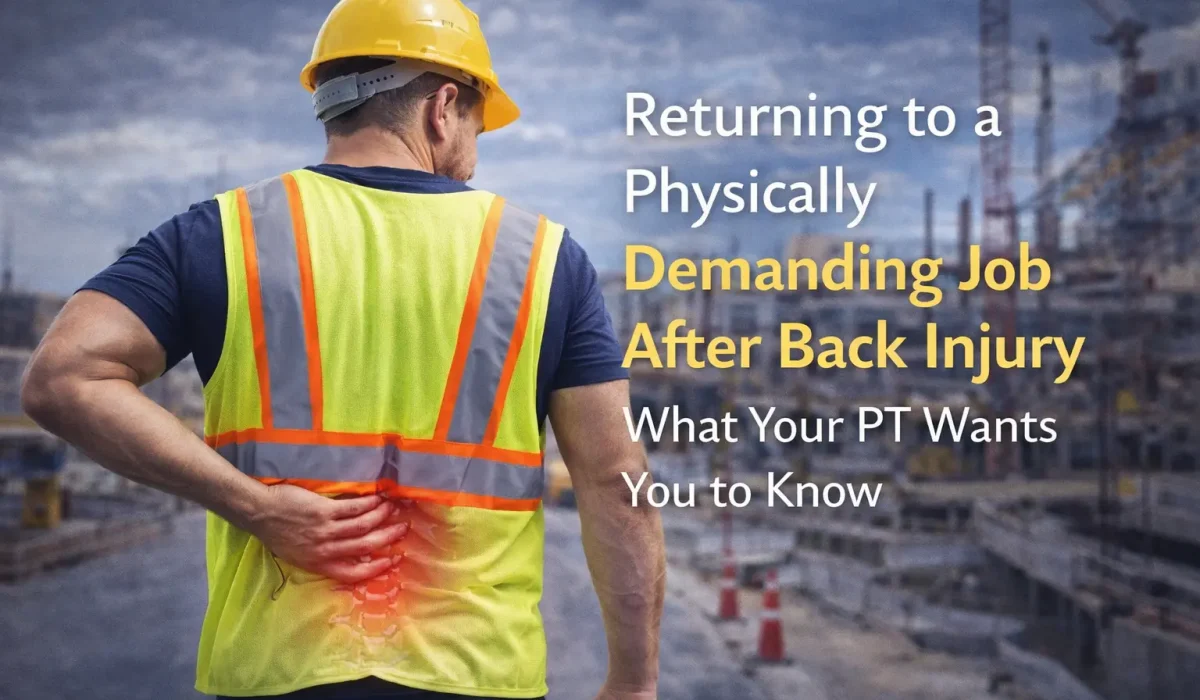
You hurt your back at work. Maybe it was a single heavy lift that sent a jolt of pain through your lower spine, or maybe it was weeks of repetitive bending and twisting that finally caught up with you. Either way, you’re now facing the question every physically active worker dreads: when can I safely get back to my job?
According to the Bureau of Labor Statistics, back injuries account for one in every five workplace injuries in the United States—more than a million cases every year. And 75% of those injuries happen during lifting tasks. For workers in construction, warehousing, healthcare, manufacturing, and the trades throughout Northeast Philadelphia and Bucks County, a back injury isn’t just a medical problem. It’s a threat to your income, your identity, and your family’s stability.
At Capstone Physical Therapy & Fitness, we’ve spent 19+ years helping Philadelphia and Bucks County workers recover from back injuries and return to physically demanding jobs safely. The key word is safely—because rushing back too soon is how a treatable strain becomes a chronic, career-limiting condition. Here’s what your physical therapist wants you to understand before you go back.
What You’ll Learn
- Why Work-Related Back Injuries Are Different from Other Back Pain
- The Real Causes Behind Recurring Back Injuries on the Job
- How to Know When You’re Actually Ready to Return
- What a Safe Return-to-Work Program Looks Like
- Why Philadelphia and Bucks County Workers Choose Capstone
- Frequently Asked Questions
Why Work-Related Back Injuries Are Different from Other Back Pain
When you hurt your back outside of work, you can rest as long as you need. You can modify your activities, take it easy, and let your body heal on its own timeline. But when your livelihood depends on physical labor—lifting, bending, carrying, climbing, standing for hours—the stakes change completely.
Work-related back injuries carry unique pressures that affect recovery:
- Financial pressure to return too soon. Every day away from work is lost income. This urgency leads many workers to go back before their bodies are ready, turning a recoverable strain into a chronic problem.
- Fear of job loss. Even with workers’ compensation protections, many Philadelphia and Bucks County workers worry about being replaced or losing their position if they’re out too long.
- Employer pressure. Some employers—intentionally or not—push workers to return before they’re medically cleared.
- The demands don’t change. Unlike an office worker who can ease back with lighter duties, your job may require the same heavy lifting on day one that caused the injury in the first place.
These pressures create a dangerous cycle: rush back, re-injure, take more time off, return again under-recovered. In our experience at Capstone, this cycle is the single biggest reason work injuries become chronic disabilities.
The Real Causes Behind Recurring Back Injuries on the Job
Understanding why your back gave out—and why it keeps giving out—is the foundation of a real recovery. Most workers assume the injury was caused by a single bad lift. In reality, the cause is almost always deeper.
Cumulative Micro-Damage
Research shows that up to 92% of back injuries result from stressful postures and repetitive strain rather than a single traumatic event. By the time your back “gives out,” weeks or months of micro-damage have already weakened the muscles, ligaments, and discs. The single lift that triggers acute pain is usually just the final straw.
Core and Hip Weakness
Your lower back was never designed to be the primary force generator during lifting and carrying. That’s your core, glutes, and hips. When these muscle groups are weak—which is extremely common in workers who perform repetitive tasks all day—your lumbar spine absorbs forces it wasn’t built to handle. This is exactly why a whole-body assessment matters. At Capstone, we consistently find that patients with recurring back pain have significant weakness in their hips and core that was never addressed in previous treatment.
Poor Lifting and Movement Mechanics
Three out of four workplace back injuries happen during lifting. But it’s rarely because the object was too heavy—it’s because the lifting technique placed excessive load on the spine. After years of repetitive work, many laborers develop compensatory movement patterns that feel normal but are quietly destroying their backs. Brian Kirby’s training in Functional Manual Reaction helps us identify these dysfunctional patterns that generic rehab programs completely miss.
Incomplete Previous Rehabilitation
This is the cause we see most often at Capstone. A worker gets hurt, goes to a high-volume PT clinic, does a few weeks of generic exercises, gets cleared, goes back to work—and re-injures within months. The pain was treated. The root cause wasn’t. The core weakness, the hip dysfunction, the faulty mechanics—all still there, waiting for the next heavy lift to trigger another episode.
How to Know When You’re Actually Ready to Return
Clearance to return to work should be based on functional milestones—not just the absence of pain. Pain can subside while the underlying weakness and dysfunction remain. Here are the signs your body is genuinely ready:
- You can perform your job’s physical demands without pain. Not just light duties—the actual lifting, bending, carrying, and sustained positions your job requires.
- Your strength is balanced. Core, hip, and back muscles should test at functional levels, not just “good enough.”
- Your movement mechanics are corrected. You can demonstrate proper lifting, bending, and carrying form under load—not just in a therapist’s office, but under realistic conditions.
- You have endurance for a full shift. Being pain-free for 30 minutes is different from being pain-free for 8 hours of physical labor.
- You’ve been tested with work simulation. Progressive work-hardening exercises that mimic your actual job demands have been completed successfully.
Remember: Pennsylvania’s Direct Access law means you don’t need a doctor’s referral to see a physical therapist. If you’re unsure whether you’re ready, schedule an evaluation at Capstone and let an experienced therapist assess your readiness objectively.
At Capstone Physical Therapy & Fitness, we don’t just reduce your pain and send you back. We prepare your body for the specific physical demands of your job. Here’s how:
Phase 1: Pain Reduction and Root Cause Identification
Your first sessions focus on calming acute symptoms while performing a comprehensive whole-body assessment. We identify every contributing factor—not just where the pain is, but why it’s there. This includes evaluating your core stability, hip strength, spinal mobility, and movement patterns. Most workers are surprised to learn that their back pain stems from weakness or stiffness somewhere else entirely.
Phase 2: Rebuild Your Foundation
Once pain is controlled, we build the strength and mobility your job demands. Core strengthening, hip stabilization, thoracic spine mobility, and progressive resistance training prepare your body to handle real-world loads. Every exercise is tailored to your specific job requirements—a warehouse worker’s program looks very different from a construction laborer’s or a nurse’s.
Phase 3: Work Simulation and Hardening
This is the phase most clinics skip—and it’s the most important one. We progressively simulate the physical tasks of your job: lifting, carrying, bending, climbing, sustained standing, and repetitive movements. The goal is to stress-test your recovery under controlled conditions so there are no surprises on your first day back. You build endurance from one-hour sessions up to the stamina needed for a full work shift.
Phase 4: Return to Work with a Prevention Plan
When you’re cleared to return, you leave with more than just relief—you leave with a maintenance exercise program designed to keep your back healthy long-term. Because our locations are in fitness facilities, many Capstone patients continue their conditioning beyond PT to prevent re-injury season after season.
Why Philadelphia and Bucks County Workers Choose Capstone PT & Fitness
Since 2007, Capstone Physical Therapy & Fitness has been the trusted choice for workers across Northeast Philadelphia, Southampton, and Morrisville who need to get back on the job safely. What makes our approach different:
- One-on-one care every session —you’re never shuffled between therapists or left to do exercises on your own while your PT treats someone else
- Same therapist throughout treatment —they know your injury, your job demands, your progress, and your goals
- Whole-body assessment —we find the root cause of your back pain, which is often different from where you feel it
- Job-specific rehabilitation —your treatment plan is built around the physical demands of your actual occupation
- Advanced credentials —Mark Donathan, PT, MS (Temple University), Brian Kirby, MSPT, FAFS, FMR (College Misericordia, Gray Institute)
As one patient, Ron Long, shared about his experience at Capstone: he walked in thinking he’d need to wait for an appointment or insurance approval, but was evaluated and received his first treatment that same afternoon. That’s the kind of responsive, personalized care every Capstone patient receives.
Frequently Asked Questions
Do I need a doctor’s referral to start physical therapy for my work injury in Pennsylvania?
No. Pennsylvania’s Direct Access law allows you to see a physical therapist without a physician referral. At Capstone, you can schedule your evaluation today and begin treatment immediately—no waiting for referral approvals.
Does Capstone accept workers’ compensation insurance?
Capstone accepts most major insurance plans. We verify your coverage before your first visit so you know exactly what to expect. Call (215) 677-1149 with specific workers’ comp or insurance questions.
How long does it take to recover from a work-related back injury?
Recovery varies by injury severity. Many workplace back injuries require 6 to 12 weeks of physical therapy with 2–3 sessions per week. More severe injuries, including disc herniations or post-surgical cases, may require several months. Your therapist will provide a realistic timeline during your initial evaluation.
Can I work while doing physical therapy for my back?
In many cases, yes—especially with modified duties. Your Capstone therapist can communicate with your employer about appropriate work restrictions during your recovery and recommend a graduated return-to-work schedule.
Why does my back keep getting re-injured when I return to work?
The most common reason is incomplete rehabilitation that treated the pain but not the underlying cause. Weak core muscles, hip dysfunction, and poor lifting mechanics persist after pain resolves—leaving you vulnerable to re-injury. Capstone’s whole-body approach addresses all contributing factors.
What types of physically demanding jobs do you help patients return to?
We work with construction workers, warehouse and logistics staff, healthcare workers, tradespeople (plumbers, electricians, HVAC technicians), manufacturing workers, landscapers, and anyone whose job requires lifting, carrying, bending, or sustained physical activity.
How is Capstone different from the PT clinic my employer sends me to?
Many employer-referred clinics use a high-volume model where you see a different therapist each visit and receive generic exercise programs. At Capstone, you receive one-on-one care with the same therapist every session, a whole-body assessment that finds root causes, and a job-specific rehabilitation plan.
Which Capstone location is closest to me?
Capstone has three locations: Northeast Philadelphia (10980 Norcom Road), Southampton (715 Cherry Lane), and Morrisville (201 Woolston Drive). We serve workers throughout Bustleton, Somerton, Fox Chase, Bensalem, Feasterville, Warminster, Richboro, Langhorne, Yardley, Levittown, and beyond.
Ready to Get Back to Work Safely?
If you’re dealing with a back injury and need to return to a physically demanding job in Philadelphia or Bucks County, don’t rush back and risk making it worse. Let Capstone help you return stronger, safer, and confident that your back can handle the demands of your work.
Schedule Your Evaluation:
- Call: (215) 677-1149
- Email: mark@capstoneptfit.com
- Online: www.capstoneptfit.com/contact-us
Choose Your Location:
- Philadelphia: 10980 Norcom Road, Philadelphia, PA 19154
- Southampton: 715 Cherry Lane, 1st Floor, Southampton, PA 18966
- Morrisville: 201 Woolston Drive, Suite 1A, Morrisville, PA 19067
What to Expect:
- Direct Access — no referral needed in Pennsylvania
- Insurance verification before your first visit
- One-on-one care with an experienced therapist
- Same therapist throughout your treatment
- Located in fitness facilities for long-term wellness
Serving Northeast Philadelphia and Lower Bucks County Since 2007
Get Better. Stay Better.