

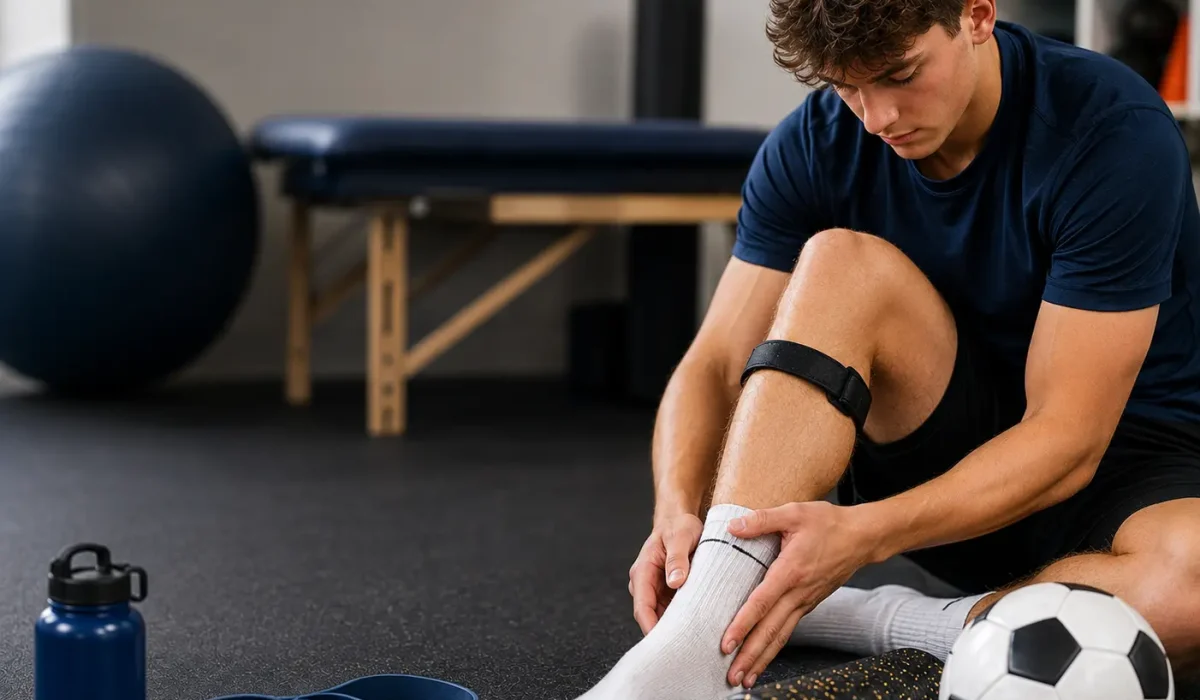
That hamstring you tweaked in a summer pickup game. The ankle you rolled at camp that still feels a little off. The knee that’s been nagging since July. Fall sports season is almost here, and across Northeast Philadelphia and Bucks County, athletes are heading into football, soccer, field hockey, and cross country tryouts carrying injuries they hoped would just “work themselves out” over the summer.
Here’s the hard truth every physical therapist knows: lingering injuries don’t resolve on their own, and pushing into a demanding fall season on an unrehabilitated injury is one of the fastest ways to turn a minor problem into a season-ending one. Research on athletes across all levels consistently shows that re-injuries keep players out longer than first-time injuries—and hamstrings, the most common muscle to re-injure, are notorious for recurring when athletes return before fully restoring strength and control.
At Capstone Physical Therapy & Fitness, we’ve spent 19+ years helping Philadelphia and Bucks County athletes rehab lingering injuries and enter their seasons at full strength. If you’re carrying something into fall preseason, here’s exactly what you need to do.
What You’ll Learn
- Why Lingering Summer Injuries Don’t Just Go Away
- The Most Common Lingering Injuries Going Into Fall Sports
- Why “Pain-Free” Doesn’t Mean “Ready to Play”
- Your Preseason Rehab Game Plan
- Why Philadelphia and Bucks County Athletes Choose Capstone
- Frequently Asked Questions
Why Lingering Summer Injuries Don’t Just Go Away
The most dangerous myth in sports is that rest alone heals an injury. Rest reduces pain and inflammation—but it does nothing to correct the underlying problems that caused the injury or that developed while you were compensating for it.
Here’s what’s actually happening with that lingering injury:
- The tissue healed, but weak. When a muscle or ligament is injured, it heals with scar tissue that’s less flexible and weaker than the original. Without proper rehabilitation, that tissue stays vulnerable and re-tears easily under the demands of sport.
- You developed compensations. When something hurts, your body unconsciously changes how you move to avoid pain. These compensations become habits—and they overload other areas, creating new injury risk far from the original site.
- Strength and control never fully returned. Even after pain fades, an injured area typically retains strength deficits and impaired neuromuscular control. Your body simply doesn’t trust the injured limb the way it did before—and that hesitation shows up as poor mechanics during cutting, sprinting, and landing.
- The root cause was never addressed. Many injuries stem from underlying issues like muscle imbalances, poor movement patterns, or weakness elsewhere in the kinetic chain. If those aren’t corrected, the injury keeps coming back.
At Capstone, we consistently see athletes who “rested” an injury all summer, felt better, then re-injured within the first two weeks of preseason—because rest addressed the symptom but not the cause.
The Most Common Lingering Injuries Going Into Fall Sports
Football, soccer, and other fall sports place specific demands on the body—and certain injuries are especially prone to lingering and recurring:
- Hamstring strains: The most commonly re-injured muscle in sports. Soccer players and football skill-position athletes are especially vulnerable. Returning before restoring full strength, flexibility, and neuromuscular control almost guarantees recurrence.
- Ankle sprains: Incompletely rehabbed ankle sprains lose the proprioception (position sense) that keeps you stable during cutting and landing. This is why one ankle sprain dramatically increases the risk of another.
- Knee pain: Patellofemoral pain and lingering ligament issues that flare with the running, jumping, and cutting fall sports demand. Often traced to hip and quad weakness.
- Groin strains: Common in soccer from kicking and rapid direction changes. Notorious for lingering when the athlete returns before full recovery.
- Shoulder issues: Relevant for football players, from tackling, blocking, and falls. Instability and rotator cuff problems that weren’t addressed become chronic under contact loads.
Why “Pain-Free” Doesn’t Mean “Ready to Play”
This is the single most important concept for any athlete with a lingering injury to understand. The absence of pain is not the same as readiness for sport.
An injury can feel fine during everyday activity—walking, climbing stairs, light jogging—while still lacking the strength, flexibility, and control needed to withstand the explosive, high-force, unpredictable demands of competitive football or soccer. Athletes who use “I don’t feel pain anymore” as their return criteria are the ones who end up re-injured.
True readiness for fall sports means:
- Full, pain-free range of motion in the injured area, matching the uninjured side
- Strength symmetry —the injured limb should be within about 90% of the strength of the uninjured limb
- Sport-specific movement without compensation —you can cut, sprint, jump, and land with proper mechanics
- Confidence at game speed —you trust the injured area during unpredictable, full-intensity play
At Capstone, our evaluations assess all of these objectively—so your return to play is based on measurable readiness, not just how you feel on a given day.
Your Preseason Rehab Game Plan
If you’re carrying a lingering injury into fall preseason, here’s how to approach it the right way.
Step 1: Get an Evaluation Now—Not After It Gets Worse
The sooner you address a lingering injury, the more time you have to rehabilitate it before season demands ramp up. Pennsylvania’s Direct Access law means you don’t need a referral—you can schedule an evaluation at Capstone today. Your therapist will identify not just the injury itself but the compensations and root causes that developed around it.
Step 2: Restore Mobility and Eliminate Compensations
Before building strength, we restore full, pain-free range of motion and correct the movement compensations that developed while you favored the injury. Brian Kirby’s training in Functional Manual Reaction and Applied Functional Science helps us identify movement dysfunctions across the entire kinetic chain—not just at the injury site.
Step 3: Rebuild Strength and Neuromuscular Control
Progressive, sport-specific strengthening restores the strength deficits that linger long after pain fades. Just as importantly, we retrain the neuromuscular control—the coordination and position sense—that keeps you stable during cutting, landing, and rapid direction changes. This is where most self-managed rehab falls short.
Step 4: Progress Through Sport-Specific Demands
Before you’re cleared, we progressively expose the injured area to the actual demands of your sport—sprinting, cutting, jumping, contact simulation—in a controlled setting. This stress-tests your recovery so there are no surprises when preseason intensity hits. We follow the principle that training load should increase gradually, never more than about 10% per week, to avoid overloading healing tissue.
Step 5: Return with a Prevention Plan
When you’re cleared to play, you leave with a maintenance program to keep the injury from recurring during the season. Many Capstone athletes continue with targeted prevention exercises all season long—because staying on the field is always better than coming back to rehab.
Why Philadelphia and Bucks County Athletes Choose Capstone PT & Fitness
Fall sports move fast, and the athletes who stay healthy are the ones who entered the season fully prepared. Since 2007, Capstone Physical Therapy & Fitness has helped athletes across Somerton, Southampton, Warminster, Richboro, Feasterville, Langhorne, Yardley, and Morrisville do exactly that:
- One-on-one care every session —your therapist works exclusively with you for the full appointment
- Same therapist throughout treatment —they know your injury, your sport, your position, and your goals
- Whole-body assessment —we find the compensations and root causes that lingering injuries create
- Sport-specific return-to-play progression —objective readiness testing, not guesswork
- Fitness facility locations —supporting your conditioning and prevention beyond PT
As one patient, Brian, shared: “Mark and Capstone were an absolute game-changer for me…from a nagging knee injury…to achieving a sub-4 hour marathon milestone.” Whether you’re chasing a starting spot or just want to make it through the season healthy, that same personalized care is what every Capstone patient receives.
Frequently Asked Questions
Should I push through a lingering injury when fall sports season starts?
No. Playing through an unresolved injury is one of the most common causes of a minor problem becoming a season-ending one. Re-injuries keep athletes out longer than first-time injuries, and an unrehabilitated injury creates compensations that increase your risk of a new injury elsewhere.
How long before fall sports season should I start rehabbing a lingering injury?
The sooner the better, but ideally at least 4–6 weeks before your first practice to properly rehabilitate and rebuild sport-specific strength. If season is closer than that, a physical therapist can still help you manage the injury and reduce re-injury risk during the season.
Do I need a doctor’s referral for physical therapy in Pennsylvania?
No. Pennsylvania’s Direct Access law allows you to see a physical therapist without a physician referral. At Capstone, you can schedule immediately and start preparing for your season right away.
What are the most common lingering injuries going into fall sports?
The most common include hamstring strains, incompletely rehabbed ankle sprains, knee pain, groin strains, and shoulder issues. Hamstring injuries in particular have high recurrence rates when athletes return before restoring full strength, flexibility, and control.
How do I know if my injury is healed enough to play?
Being pain-free at rest isn’t the same as being ready for sport. True readiness means full pain-free range of motion, strength symmetry between sides, the ability to perform sport-specific movements without compensation, and confidence at game speed. A physical therapist can assess these objectively.
Can physical therapy help even if my injury happened months ago?
Absolutely. Lingering injuries present for weeks or months often involve compensations and underlying weaknesses a physical therapist can identify and correct. It’s never too late to properly rehabilitate an injury and reduce your risk of it becoming chronic.
Does Capstone accept my insurance?
Capstone accepts most major insurance plans and verifies coverage before your first visit. Call (215) 677-1149 with specific insurance questions.
Which Capstone location is closest to me?
Capstone has three locations: Northeast Philadelphia (10980 Norcom Road), Southampton (715 Cherry Lane), and Morrisville (201 Woolston Drive). We serve athletes throughout Bustleton, Somerton, Fox Chase, Feasterville, Warminster, Richboro, Hatboro, Langhorne, Yardley, Levittown, and beyond.
Don’t Let a Summer Injury Sideline Your Fall Season
The time to address that lingering injury is now—before preseason intensity turns a manageable problem into a season-ending one. At Capstone Physical Therapy & Fitness, we’ll get you back to full strength and confident on the field.
- Call: (215) 677-1149
- Email: mark@capstoneptfit.com
- Online: www.capstoneptfit.com/contact-us
Choose Your Location:
- Philadelphia: 10980 Norcom Road, Philadelphia, PA 19154
- Southampton: 715 Cherry Lane, 1st Floor, Southampton, PA 18966
- Morrisville: 201 Woolston Drive, Suite 1A, Morrisville, PA 19067
What to Expect:
- Direct Access — no referral needed in Pennsylvania
- Insurance verification before your first visit
- One-on-one care with an experienced therapist
- Same therapist throughout your treatment
- Located in fitness facilities for long-term wellness
Serving Northeast Philadelphia and Lower Bucks County Since 2007
Get Better. Stay Better.
About the Author
Mark Donathan, PT, MS
Mark Donathan founded Capstone Physical Therapy & Fitness in 2007 with a simple mission: provide the personalized, one-on-one care that patients deserve. A 1999 graduate of Temple University’s physical therapy program, Mark has spent over 27 years helping Philadelphia and Bucks County residents recover from injuries, manage chronic pain, and return to active lives. His advanced training includes orthopedic physical therapy techniques and hands-on manual therapy approaches. Mark believes in treating the whole person, not just the symptom—finding root causes that other clinics miss.