

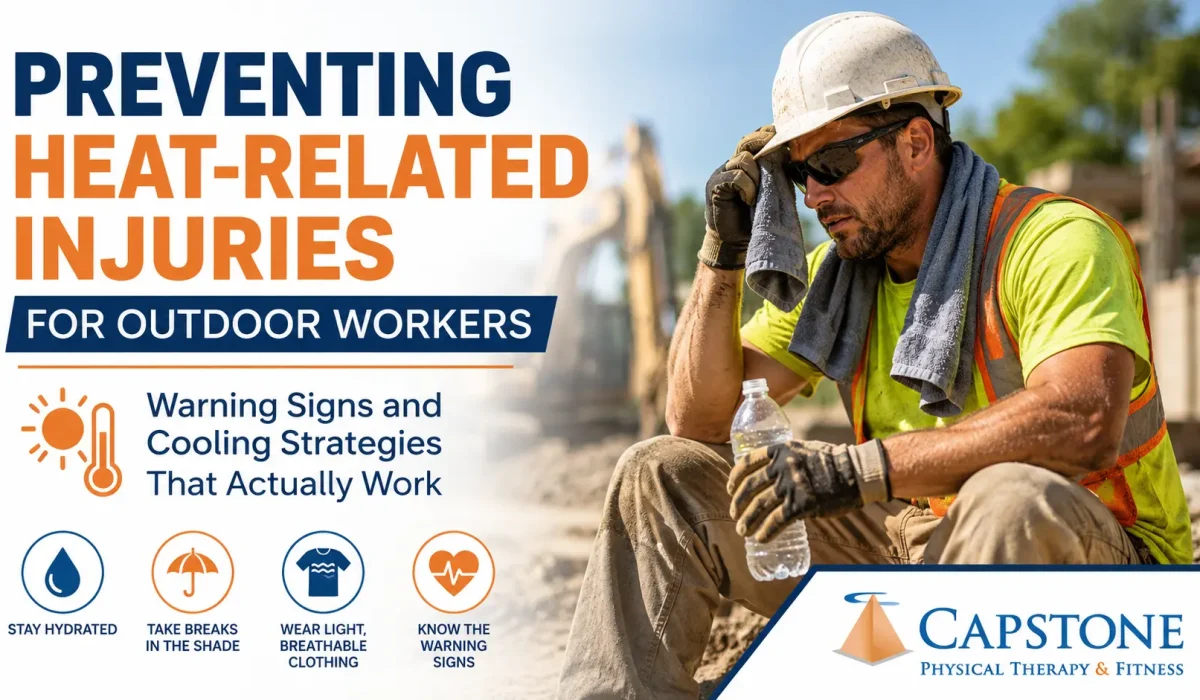
Summer in the Philadelphia area means heat, humidity, and longer workdays for the landscapers, construction workers, roofers, and tradespeople who power our communities. And every summer at Capstone Physical Therapy & Fitness, we see the same pattern: a surge of strains, sprains, and overuse injuries from outdoor workers whose bodies broke down in the heat.
Most people associate working in extreme heat with heat stroke and heat exhaustion. Those are real and dangerous. But what most outdoor workers don’t realize is that heat causes far more musculoskeletal injuries than heat illness alone. A landmark study from George Washington University and Harvard found that approximately 28,000 workplace injuries per year are directly linked to hot weather—and those injuries include back strains, shoulder tears, ankle sprains, and falls, not just heat-related illness.
At Capstone, we’ve spent 19+ years treating the workers who build and maintain Northeast Philadelphia and Bucks County. Here are the warning signs you need to recognize and the cooling strategies that actually prevent injuries—not just heat stroke.
What You’ll Learn
- How Heat Causes Musculoskeletal Injuries (Not Just Heat Illness)
- The Warning Signs Every Outdoor Worker Must Recognize
- Cooling and Hydration Strategies That Actually Work on the Job
- When a Heat-Season Injury Needs Professional Attention
- Why Philadelphia and Bucks County Workers Choose Capstone
- Frequently Asked Questions
How Heat Causes Musculoskeletal Injuries—Not Just Heat Illness
Everyone knows heat can cause heat stroke. But most workers and employers don’t understand that heat is quietly increasing the risk of every other injury on the job site, too. Here’s the chain reaction happening inside your body when you work in high temperatures:
Dehydration Weakens Your Muscles
When you sweat heavily without replacing fluids fast enough, your muscles lose the blood flow and hydration they need to contract forcefully and absorb impact. Dehydrated muscles cramp more easily, fatigue faster, and lose their ability to stabilize your joints during heavy lifting, carrying, and climbing. That back strain at 2 PM on a 95-degree day? It probably started with inadequate hydration at 9 AM.
Heat Fatigue Degrades Your Coordination
As your core body temperature rises, your central nervous system diverts resources toward cooling. The result is measurably slower reaction times, reduced coordination, and impaired decision-making. Research shows that even moderate heat significantly increases injury risk across nearly every industry. Workers on hot days are more likely to trip, lose their grip, misjudge a lift, or step wrong on uneven terrain—not because they’re careless, but because their nervous system is operating at reduced capacity.
Sweat Compromises Grip and Footing
Sweaty palms reduce grip strength on tools, materials, and handrails. Wet boots lose traction on ladders and scaffolding. These may seem like minor factors, but on a construction site or landscaping job, a momentary slip with a heavy load is all it takes to strain a back, tear a shoulder, or sprain an ankle.
Unacclimatized Workers Face the Highest Risk
OSHA identifies lack of heat acclimatization as one of the primary risk factors for heat-related injury and illness. Workers who haven’t spent time recently in hot environments—including those returning from vacation, a long weekend, or time off due to injury—need 1 to 2 weeks of gradually increasing heat exposure to adapt safely. The first few hot days of Philadelphia’s summer are among the most dangerous for this exact reason.
The Warning Signs Every Outdoor Worker Must Recognize
Heat-related problems exist on a spectrum. Catching them early is the difference between taking a 15-minute break and taking a trip to the emergency room.
Stage 1: Heat Cramps (Early Warning)
- What you’ll feel: Painful muscle spasms, usually in the legs, arms, or abdomen, during or after heavy exertion in the heat.
- What it means: Your body is running low on fluids and electrolytes. Muscles can no longer contract normally.
- What to do: Stop working, rest in shade, drink water or a sports drink, and stretch the cramping muscles gently. Do not return to heavy work until cramps resolve completely.
Stage 2: Heat Exhaustion (Serious)
- What you’ll feel: Heavy sweating, weakness, cold or clammy skin, nausea, dizziness, headache, fast or weak pulse. You may feel like you’re about to pass out.
- What it means: Your body’s cooling system is overwhelmed. Core temperature is rising dangerously.
- What to do: Move to air conditioning or shade immediately. Loosen clothing, apply cool cloths, and sip water. If symptoms persist beyond 15 minutes or worsen, seek medical attention.
Stage 3: Heat Stroke (Emergency)
- What you’ll see: High body temperature (above 103°F), hot and red skin that may be dry or damp, rapid and strong pulse, confusion, slurred speech, loss of consciousness.
- What it means: The body has lost its ability to regulate temperature. This is a medical emergency.
- What to do: Call 911 immediately. Move the person to a cooler environment and begin cooling with any means available. Do not give fluids if the person is unconscious.
The critical message for outdoor workers: Don’t wait for heat stroke symptoms to take heat seriously. By the time you reach Stage 1, your muscles are already compromised and your injury risk has already climbed. The musculoskeletal injuries—the back strains, shoulder tears, and ankle sprains—happen during Stages 1 and 2, before heat stroke ever enters the picture.
Cooling and Hydration Strategies That Actually Work on the Job
These aren’t theoretical suggestions from a climate-controlled office. These are practical strategies for workers who have to get the job done in the heat.
Hydrate Before You’re Thirsty
OSHA recommends drinking water every 15 minutes when working in the heat, even when you don’t feel thirsty. A solid target is 24 to 32 ounces per hour during heavy outdoor work. By the time thirst kicks in, you’re already dehydrated enough to affect muscle function. Start hydrating before you leave for the job site—not after your first break.
Schedule Heavy Work for Cooler Hours
When possible, front-load the most physically demanding tasks—heavy lifting, digging, roofing—into the early morning hours before peak heat. Save lighter tasks like cleanup, measuring, and planning for the hottest part of the afternoon. This isn’t just comfort—it directly reduces your injury risk during the hours when your muscles are most vulnerable.
Take Real Breaks in Real Shade
Sitting on a hot truck bed in direct sun is not a break. Effective cooling requires actual shade or air conditioning, water consumption, and enough time for your core temperature to begin dropping. Even 10 minutes in genuine shade with fluids can significantly reduce your risk for the next work period.
Wear Appropriate Clothing
Lightweight, light-colored, loose-fitting clothing allows sweat to evaporate—your body’s primary cooling mechanism. Cooling towels around the neck and moisture-wicking fabrics make a measurable difference. Dark, heavy clothing traps heat and accelerates fatigue.
Acclimatize Gradually
If you’re starting a new outdoor job, returning from time off, or facing the first hot stretch of Philadelphia’s summer, ease into full workload over 1 to 2 weeks. Your body adapts to heat through increased sweat production, improved cardiovascular efficiency, and better fluid retention—but these adaptations take time. Employers who ignore acclimatization protocols put their workers at the highest risk.
When a Heat-Season Injury Needs Professional Attention
If the heat has already taken its toll—a back strain from a fatigued lift, a shoulder injury from a slip, knee pain from compensating on uneven ground—don’t assume it’ll resolve on its own over the weekend. Heat-season injuries often sit on top of existing weaknesses that the heat simply exposed.
At Capstone Physical Therapy & Fitness, we consistently find that workers who get hurt during summer heat have underlying issues that made them vulnerable: weak core muscles that couldn’t protect the spine when fatigued, tight hip flexors from driving to job sites, or thoracic spine stiffness that forced their shoulders to compensate. These root causes don’t go away when the temperature drops—they just wait for the next hot day to cause another injury.
Pennsylvania’s Direct Access law means you don’t need a doctor’s referral. If you’re dealing with pain from a heat-season injury, schedule your evaluation at Capstone today.
Why Philadelphia and Bucks County Workers Choose Capstone PT & Fitness
Since 2007, Capstone Physical Therapy & Fitness has been helping outdoor workers across Northeast Philadelphia, Southampton, and Morrisville recover from injuries and get back on the job safely. What makes our approach different:
- One-on-one care every session —your therapist works exclusively with you for the full appointment
- Same therapist throughout treatment —they know your job demands, your injury patterns, and your goals
- Whole-body assessment —we find the underlying weaknesses and imbalances that heat exposed
- Job-specific rehabilitation —your plan matches the physical demands of construction, landscaping, roofing, or whatever your trade requires
- Direct Access —no referral needed in Pennsylvania
- Fitness facility locations —supporting your conditioning beyond PT to prevent the next injury
Frequently Asked Questions
How does heat cause musculoskeletal injuries, not just heat illness?
Heat causes dehydration, which reduces blood flow to muscles and impairs their ability to absorb force and protect your joints. Fatigue from working in heat also slows reaction time and degrades coordination. Research shows approximately 28,000 workplace injuries per year are linked to hot days—including strains, sprains, and falls.
What are the early warning signs of heat exhaustion?
Heavy sweating, weakness, cold or clammy skin, nausea, dizziness, headache, fast or weak pulse, and muscle cramps. If you experience these symptoms, stop working immediately, move to shade, and drink water. If symptoms persist beyond 15 minutes, seek medical attention.
How much water should outdoor workers drink in the heat?
OSHA recommends drinking water every 15 minutes when working in heat. A general guideline is 24 to 32 ounces per hour during heavy outdoor work. By the time you feel thirsty, you’re already dehydrated enough to affect muscle function.
Do I need a doctor’s referral for physical therapy in Pennsylvania?
No. Pennsylvania’s Direct Access law allows you to see a physical therapist without a physician referral. At Capstone, you can schedule your evaluation immediately.
Can physical therapy help with recurring heat-season injuries?
Absolutely. Workers who get hurt repeatedly during summer often have underlying weaknesses or movement dysfunctions that make them vulnerable when heat-induced fatigue sets in. Capstone’s whole-body assessment identifies and corrects these issues before they cause another injury.
What is heat acclimatization and why does it matter?
Heat acclimatization is the process of gradually increasing heat exposure over 1–2 weeks so your body adapts. Unacclimatized workers are at significantly higher risk, especially during the first hot days of summer or after returning from time off.
Does Capstone accept my insurance?
Capstone accepts most major insurance plans and verifies coverage before your first visit. Call (215) 677-1149 with specific insurance questions.
Which Capstone location is closest to me?
Capstone has three locations: Northeast Philadelphia (10980 Norcom Road), Southampton (715 Cherry Lane), and Morrisville (201 Woolston Drive). We serve workers throughout Bustleton, Somerton, Fox Chase, Bensalem, Feasterville, Warminster, Richboro, Langhorne, Yardley, Levittown, and beyond.
Don’t Let the Heat Take You Out of the Game
Whether you need to prepare your body for summer work or you’re already dealing with an injury from the heat, Capstone Physical Therapy & Fitness is here to help you stay on the job safely.
- Call: (215) 677-1149
- Email: mark@capstoneptfit.com
- Online: www.capstoneptfit.com/contact-us
Choose Your Location:
- Philadelphia: 10980 Norcom Road, Philadelphia, PA 19154
- Southampton: 715 Cherry Lane, 1st Floor, Southampton, PA 18966
- Morrisville: 201 Woolston Drive, Suite 1A, Morrisville, PA 19067
What to Expect:
- Direct Access — no referral needed in Pennsylvania
- Insurance verification before your first visit
- One-on-one care with an experienced therapist
- Same therapist throughout your treatment
- Located in fitness facilities for long-term wellness
Serving Northeast Philadelphia and Lower Bucks County Since 2007
Get Better. Stay Better.
About the Author
Mark Donathan, PT, MS
Mark Donathan founded Capstone Physical Therapy & Fitness in 2007 with a simple mission: provide the personalized, one-on-one care that patients deserve. A 1999 graduate of Temple University’s physical therapy program, Mark has spent over 27 years helping Philadelphia and Bucks County residents recover from injuries, manage chronic pain, and return to active lives. His advanced training includes orthopedic physical therapy techniques and hands-on manual therapy approaches. Mark believes in treating the whole person, not just the symptom—finding root causes that other clinics miss.